Run the notebook.
Commit a chain.
Audit a claim.
Eigenius runs on your laptop. The walkthrough is a notebook; each cell commits a typed artifact to the chain, and the kernel type-checks the composition as it goes. By the end you have a machine-checkable audit trail from six raw plate-reader readings to a published-style designation.
The notebook is the platform.
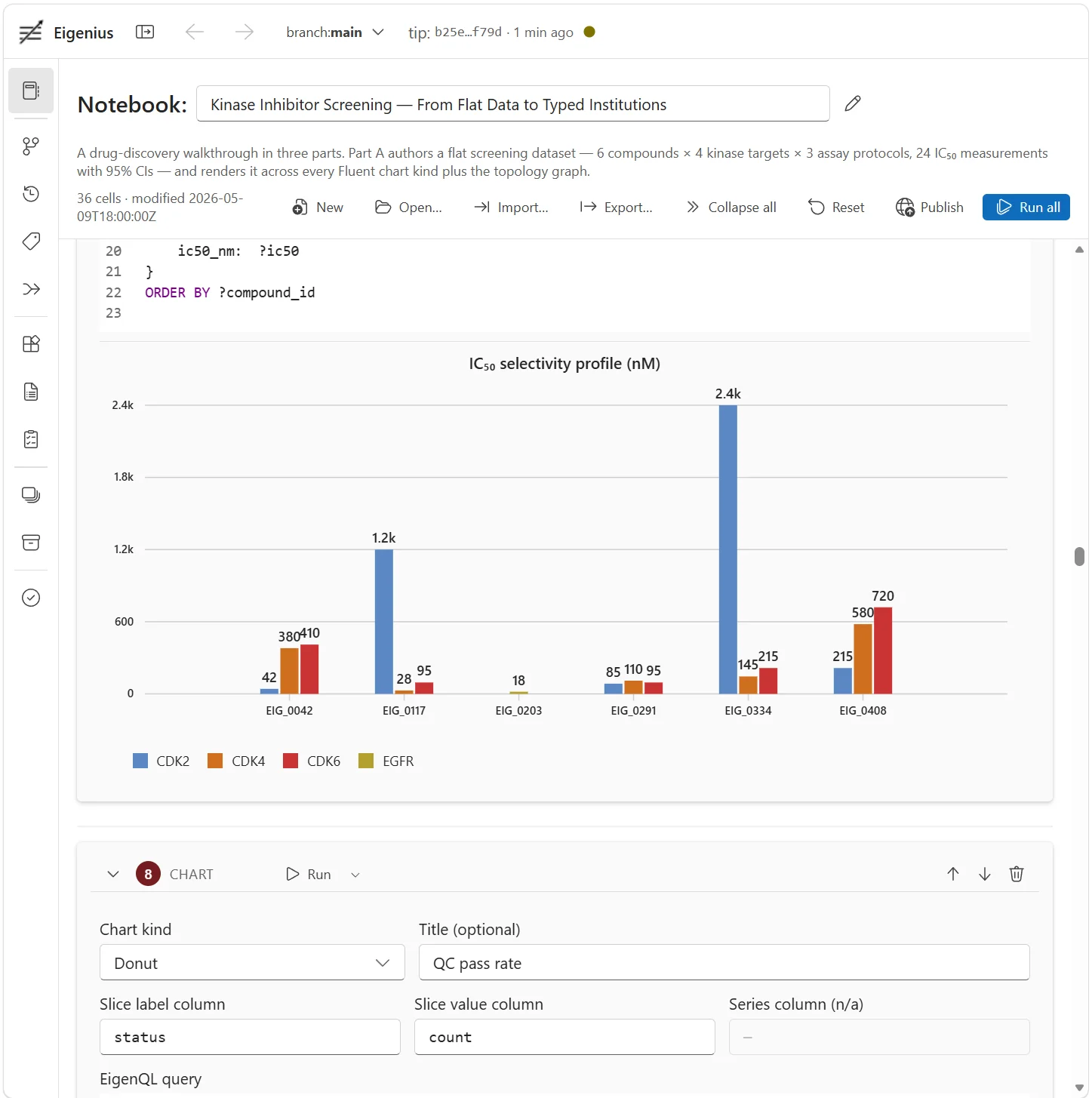
Every cell commits a typed chain artifact. The right pane surfaces the audit trail the kernel just type-checked — not a rendered summary, the actual chain. Below is the drug-screening walkthrough partway through.
Three steps to a running chain.
The end-to-end demo runs entirely in Docker — no Rust or Deno on the host required. If you'd rather build from source, follow Platform §2 — Installation instead.
- 01
Clone and start the stack
git clone https://github.com/eigenius/eigenius
cd eigenius
docker compose up -d
Requires Docker Desktop or Docker Engine + Compose v2. The first run pulls images and seeds the layer chain — allow a couple of minutes.
- 02
Open the notebook
http://localhost:8080/notebooks/No login. Everything runs on your laptop. The orchestrator serves the React notebook and proxies EigenQL/ESL into the kernel over gRPC.
- 03
Run the drug-screening walkthrough
Open
examples/stats-and-reasoning.jsonand run cells top to bottom. About five minutes end-to-end. Watch the AutoOnLoad cascades fire as the statistics institution emits its verdict and the reasoning institution composes the certificate.Read the walkthrough first Platform §14 — Notebook reference
The chain, now machine-inspectable.
By the time the last cell runs, you have committed:
- Observed six raw plate-reader IC₅₀ measurements, each carrying its instrument provenance.
- Derived a deterministic statistical verdict, recomputable by anyone with read access to the chain.
- Declared a chain-resident methodology — the polymorphic domain bridge from statistical claim to compound classification, on the record as its own citable artifact.
- Derived the final conclusion as a typed proof term the kernel checked at commit time. No prose, no hidden assumptions.
A reviewer (or another AI agent, or a regulator) can now walk back from the conclusion to the raw data in finite steps, re-execute any deterministic step, and refute any premise without disputing the rest.
Three directions from here.
The framework's vocabulary in narrative form.
- The four-warrant taxonomy: Observed, Derived, Verified, Declared
- Domain bridges: cross-vocabulary translation as data
- Institutions: how runtimes cooperate without sharing a language
Worked end-to-end walkthroughs.
- Drug screening: the statistics + reasoning pair
- Kinase potency mapping: five Julia institutions in concert
- Lean-verified primary endpoint (planned)
Surface languages, queries, and the platform.
- ESL — declare ontologies and typed programs
- EigenQL — query the layered Eigon graph
- Composition, formula language, platform internals
Stuck? Found a bug?
Project tracking lives on GitHub. Use Discussions for open-ended questions and design conversations; file an Issue with the smallest reproduction you can manage when something is broken. For private deployments and commercial questions, see the contact note in the repo README.